Technical Architecture
Understand the MAX API architecture from unified ingress and request governance to relay, asynchronous tasks, billing, and data infrastructure.
MAX API System Architecture
MAX API sits between callers and upstream model services. Its unified ingress serves the web console, management APIs, real-time model relay, and asynchronous multimodal tasks while keeping authentication, routing, rate limiting, billing, auditing, and operations within one governance boundary.
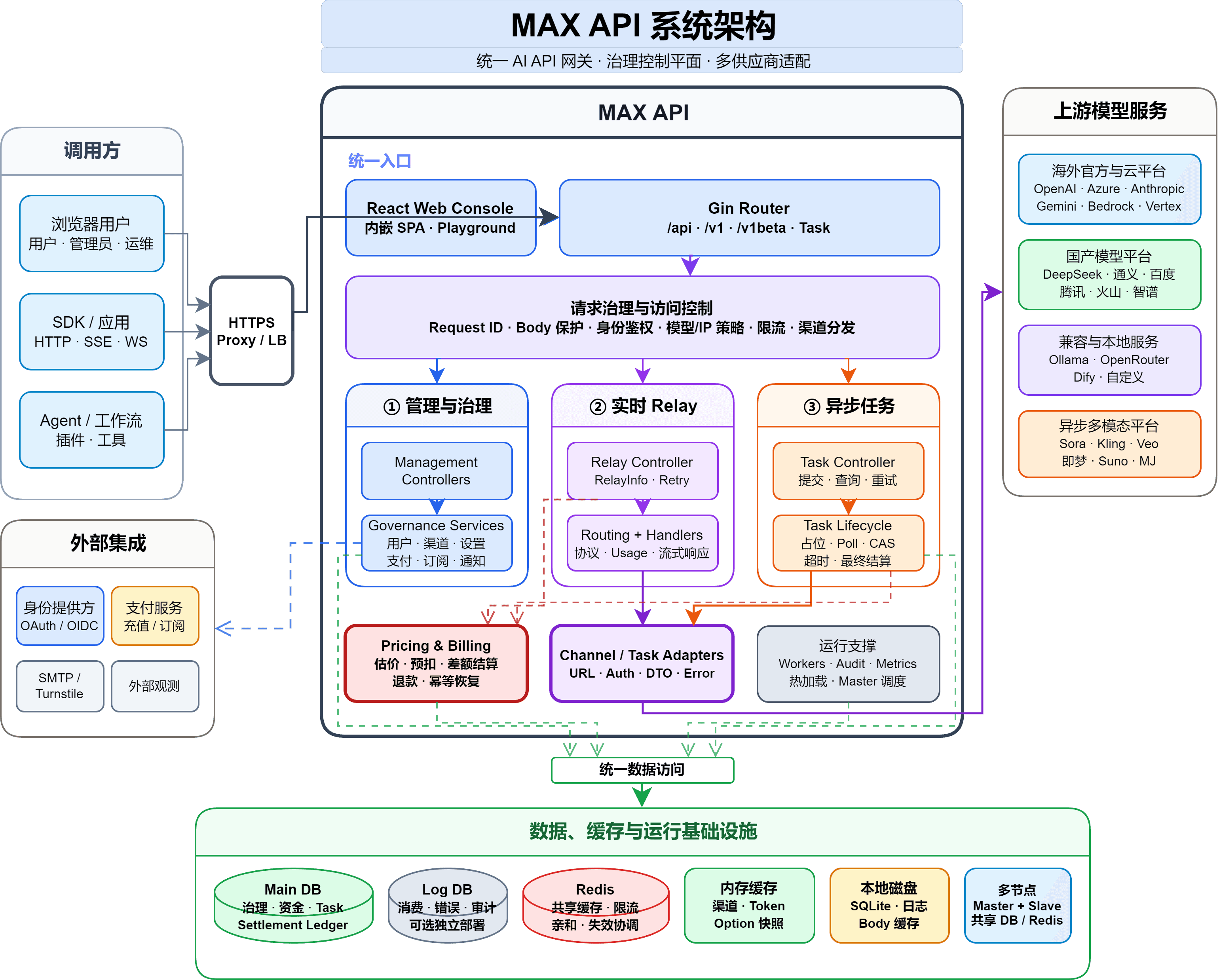
The architecture consists of four cooperating areas:
- Unified ingress and request governance: the React Web Console and Gin Router receive console traffic and
/api,/v1,/v1beta, and Task requests, then apply request identification, body protection, authentication, model and IP policies, rate limits, and channel distribution. - Control plane and data plane: management and governance services cover users, channels, settings, payments, subscriptions, and notifications. Real-time Relay and asynchronous task pipelines handle synchronous model calls and tasks that require polling, retries, and final settlement.
- Adapters and billing: channel and task adapters normalize URLs, authentication, DTOs, and errors. Pricing & Billing performs estimation, reservation, delta settlement, refunds, and exceptional recovery.
- Runtime infrastructure: Main DB, Log DB, Redis, in-memory caches, local storage, and multi-node deployments support governance data, audit logs, rate limits, task state, and runtime caches.
Component View
The component view below further shows how the web frontend, Go backend, relay system, storage, and upstream AI services relate to each other.

How is this guide?